
Home / Specialties & Services / Joint Replacement Surgery / Total Hip Replacement
Knee pain that stops you from walking to the temple, climbing stairs or sleeping through the night is not something you have to live with. When arthritis has worn away the cartilage of the whole knee, total knee replacement (TKR) can relieve pain and help you get back to everyday life.
At Mitra Orthopaedic Super Speciality Hospital, Shyamal Cross Road, Ahmedabad, knee replacement is planned and performed by orthopaedic surgeons who work exclusively on bones and joints – from your first consultation and X-ray to surgery, physiotherapy and follow-up.
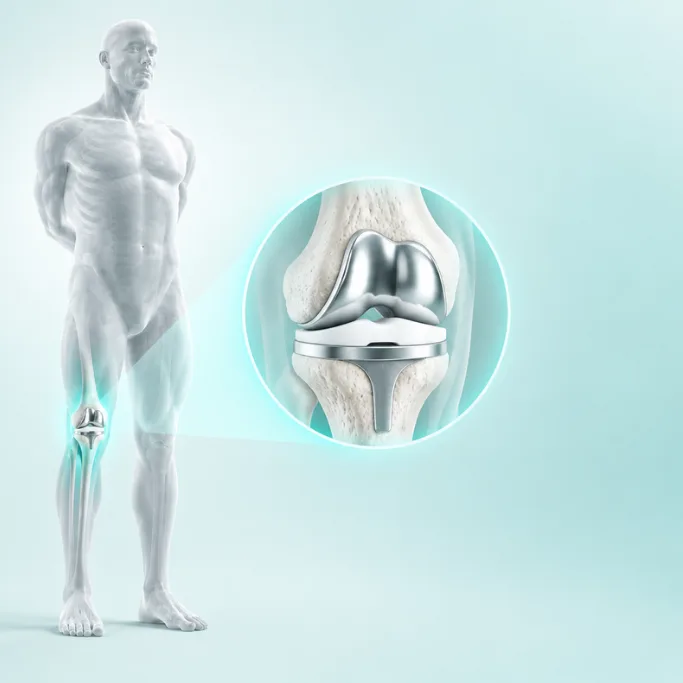
In total knee replacement, the damaged cartilage and a thin layer of bone are removed from the ends of the thigh bone (femur) and shin bone (tibia). They are replaced with precisely fitted metal components, with a medical-grade plastic spacer between them that allows smooth movement. If needed, the under-surface of the kneecap is also resurfaced.
The aim of surgery is simple: a knee that moves smoothly without the grinding pain of arthritis, and a straighter leg if your knee has become bowed or knock-kneed.
Knee replacement is usually advised after medicines, physiotherapy and injections have stopped giving relief. You may be a candidate if you have:
If you are troubled by knee pain but are not sure whether you need surgery, an evaluation with our orthopaedic doctors in Ahmedabad is the right first step. Many patients are first treated without surgery through our pain management programme.
Not every arthritic knee needs a total replacement. If arthritis is limited to one part of the knee usually the inner side and the ligaments are healthy, a partial knee replacement may be suitable.
| Total Knee Replacement (TKR) | Microplasty / UKR | |
|---|---|---|
| Area replaced | Entire knee joint surfaces | Only the damaged compartment |
| Best suited for | Arthritis across the whole knee, deformity | Arthritis in one compartment, intact ligaments |
| Incision | Standard | Smaller |
| Recovery | Gradual over 6–12 weeks | Usually quicker |
Your surgeon will recommend the option that fits your X-rays, examination and lifestyle read more about microplasty knee surgery in Ahmedabad.
Like any major surgery, knee replacement carries some risks, including infection, blood clots, stiffness and implant wear over time. Our team reduces these risks with careful pre-operative assessment, antibiotic protocols, early mobilisation, blood-clot prevention and structured follow-up. Your surgeon will explain the risks that apply to you before you decide.
Your surgeon examines your knee, reviews standing X-rays and discusses all treatment options with you and your family.
Blood tests, ECG and a physician review make sure you are fit for surgery. Diabetes, blood pressure and other conditions are brought under control before the operation.
The operation is done under spinal or regional anaesthesia and usually takes about 1 to 2 hours per knee. It is performed in a dedicated operation theatre with strict infection-control protocols.
Physiotherapy begins within a day of surgery. Most patients stay in hospital for 3 to 5 days, depending on their recovery.
You receive a home exercise programme and regular follow-up visits to track bend, strength and walking.
| Time after surgery | What to expect (typical) |
|---|---|
| Day 1–2 | Standing and walking a few steps with a walker under supervision |
| Week 1–2 | Walking at home with a walker exercises to improve bend stitches or staples checked |
| Week 3–6 | Shifting to a stick or walking independently climbing stairs with support |
| Week 6–12 | Return to most daily activities driving when cleared by your surgeon |
| 3 months onwards | Continued improvement in strength and comfort for up to a year |
Every patient recovers differently. Your surgeon and physiotherapist will set a plan for you.
Like any major surgery, knee replacement carries some risks, including infection, blood clots, stiffness and implant wear over time. Our team reduces these risks with careful pre-operative assessment, antibiotic protocols, early mobilisation, blood-clot prevention and structured follow-up. Your surgeon will explain the risks that apply to you before you decide.
Everything you need to know about total knee replacement in one place.
The cost depends on whether one or both knees are operated, the type of implant chosen, the room category, any other health conditions and the length of hospital stay. After examining you and reviewing your X-rays, our team gives you a written estimate before surgery. Please call +91 82380 87370 to book an evaluation.
Modern knee implants are designed to last for many years, and a large majority continue to work well 15 to 20 years after surgery. Keeping a healthy weight, staying active with low-impact exercise and attending follow-up visits help the implant last longer.
Yes, if your general health allows it. Replacing both knees in one sitting (bilateral TKR) means one anaesthesia and one recovery period, but it is a bigger operation. Your surgeon and physician will assess your heart, lungs and blood reports before advising whether one-stage or two-stage surgery is safer for you.
Most patients stand and take a few steps with a walker within a day of surgery under the physiotherapist's guidance. Many walk independently in about 3 to 6 weeks, and return to most daily activities within 6 to 12 weeks. Recovery varies from person to person.
Many patients regain enough bend to climb stairs, sit on a chair and use an Indian-style toilet with support. Deep squatting and sitting cross-legged are possible for some patients but are not advised for everyone, because they put extra load on the implant. Your surgeon will guide you based on your knee.
No. Early arthritis is usually treated with medicines, physiotherapy, weight management and injections. If only one compartment of the knee is damaged, microplasty (partial knee replacement / UKR) may be suitable. Total knee replacement is advised when arthritis affects the whole joint and other treatments no longer give relief.
From joint pain to complex fractures, our orthopedic doctors in Ahmedabad treat the full spectrum of bone, joint and spine conditions.
Expert diagnosis and treatment for foot and ankle pain, injuries, and conditions affecting mobility.
Expert diagnosis and treatment for foot and ankle pain, injuries, and conditions affecting mobility.
Expert diagnosis and treatment for foot and ankle pain, injuries, and conditions affecting mobility.
Expert diagnosis and treatment for foot and ankle pain, injuries, and conditions affecting mobility.


Restoring Mobility, Enhancing Lives. Ahmedabad’s trusted orthopedic hospital for Microplasty, joint replacement and complete bone & joint care.
Restoring Mobility, Enhancing Lives. Ahmedabad’s trusted orthopedic hospital for Microplasty, joint replacement and complete bone & joint care.