
Picture a 62-year-old retired bank officer from Vastrapur sitting in an orthopaedic OPD with two printouts in his hand. One says “total knee replacement”. The other says “partial knee replacement”. His neighbour had one. His cousin had the other. Both are happy.
So which one should he get?
Honestly, that’s the wrong way to ask it. Neither surgery is better across the board. One of them fits your knee, and the X-ray usually tells us which one. Here’s how surgeons actually make that call, explained the way we’d explain it to you across the table.
Quick Answer Partial knee replacement (also called Microplasty or Oxford partial knee replacement) replaces only the worn-out compartment of the knee, usually the inner side. Total knee replacement resurfaces all three compartments. Partial suits arthritis limited to one area with healthy ligaments. Total suits arthritis spread across the knee, large deformities or damaged ligaments. |
What Is the Difference Between Partial and Total Knee Replacement?
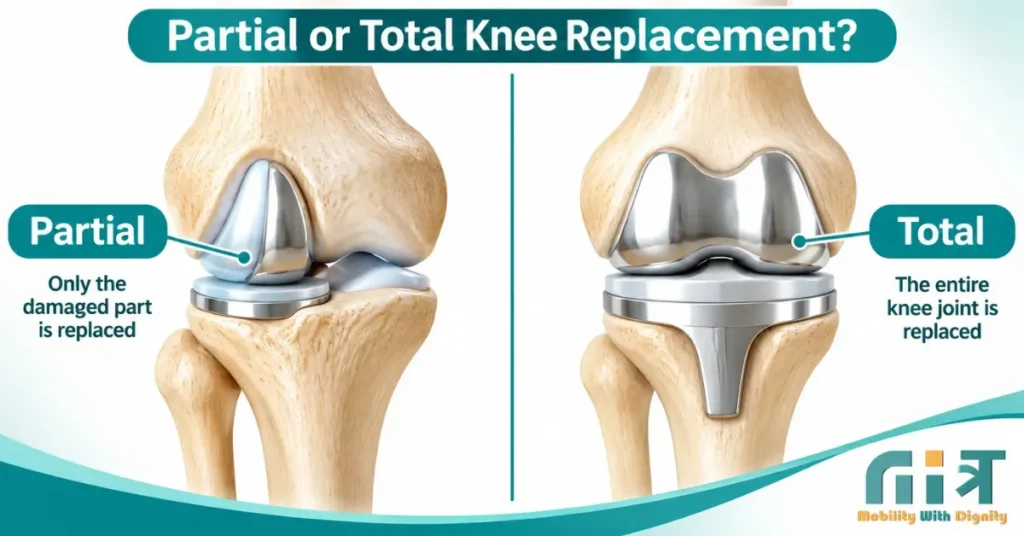
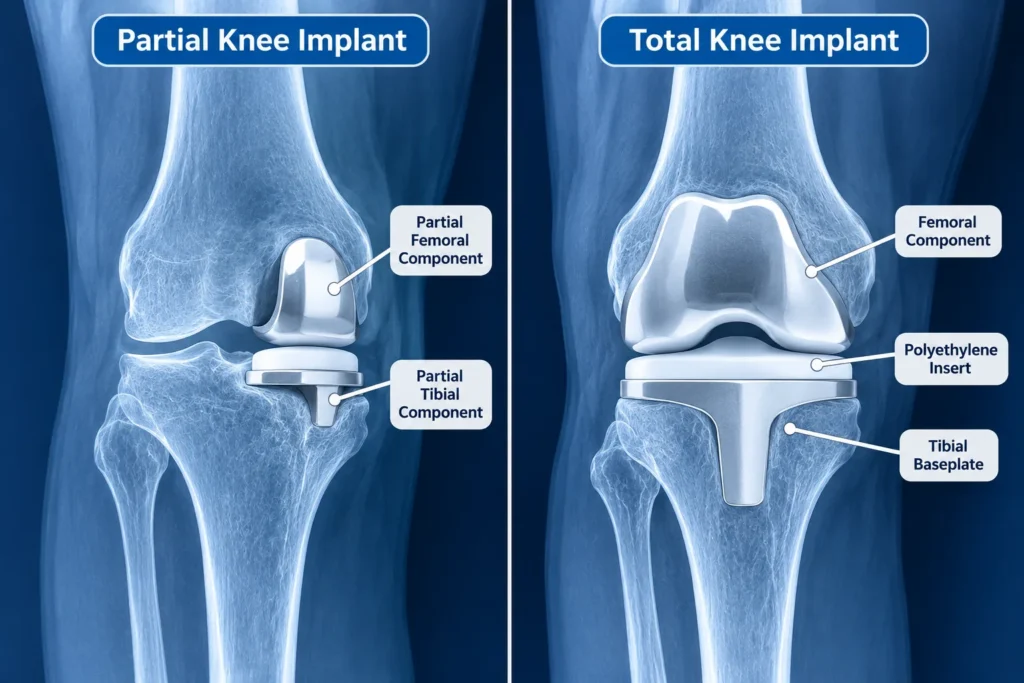
The difference is how much of the knee gets replaced. A partial knee replacement resurfaces only the damaged compartment. A total knee replacement resurfaces the entire joint.
Your knee has three compartments: inner (medial), outer (lateral) and behind the kneecap (patellofemoral). Arthritis rarely wears them out evenly.
In many Indian patients, the inner compartment goes first (bow legs and years of squatting play a part). If the other two still have healthy cartilage, it makes sense to replace only the worn side. That’s a partial knee replacement, also called unicompartmental knee replacement, Oxford partial knee replacement or Microplasty.
Partial vs Total Knee Replacement at a Glance
| Factor | Partial Knee Replacement (Microplasty) | Total Knee Replacement |
|---|---|---|
| Part of knee replaced | One compartment only | All three compartments |
| Ligaments (ACL) | Kept intact | ACL usually removed |
| Incision size | Approx. 8 to 10 cm | Approx. 15 to 20 cm |
| Hospital stay | Approx. 1 to 3 days | Approx. 3 to 5 days |
| Walking with support | Often the same day | Within approx. 24 to 48 hours |
| Back to daily routine | Approx. 3 to 6 weeks | Approx. 6 to 12 weeks |
| Suits | Arthritis in one area, healthy ligaments | Widespread arthritis, deformity, ligament damage |
| Approx. cost in Ahmedabad (per knee) | Rs 1.5 to 3 lakh | Rs 1.8 to 4.5 lakh |
Figures are approximate and vary by patient.
Who Is a Good Candidate for Partial Knee Replacement?
You may be suitable for a partial knee replacement if your arthritis is limited to one compartment and your knee ligaments, especially the ACL, are still healthy. Standing X-rays, and sometimes an MRI, confirm this.
Signs that usually point towards a partial:
- Pain mostly on the inner side, in a spot you can point to with one finger
- X-rays showing bone-on-bone wear in one compartment only
- An intact ACL (the ligament that stops the shin bone from sliding forward)
- A bow-leg deformity that still corrects when the leg is straightened
- Good knee bend, usually more than approximately 90 to 100 degrees
What Most People Don’t Know
Age and weight matter less than they used to. A fit 75-year-old with one-sided wear can be a better partial candidate than a 55-year-old whose arthritis has spread everywhere.
Timing matters more. Arthritis that starts in one compartment can spread to the others over a few years, so patients who keep postponing surgery sometimes lose the option of a partial.
When Is Total Knee Replacement the Better Choice?
Total knee replacement is usually the right choice when arthritis has damaged two or all three compartments, when the ACL is torn or worn out, or when the leg has a large fixed deformity. It’s also the standard option for most patients with rheumatoid arthritis.
Here’s the thing. A total knee isn’t a “more serious” version of a partial. It’s a different tool for a different problem, with a long track record. And a well-chosen total knee will serve you far better than a partial forced into a knee that isn’t suited for it.
How Long Does Recovery Take After Each Surgery?
Partial knee patients usually return to daily routines in approximately 3 to 6 weeks, compared with approximately 6 to 12 weeks after a total knee replacement. Both need structured physiotherapy.

A typical recovery:
- Days 1 to 2: You walk with a walker, often the same day after a partial and within about 24 to 48 hours after a total.
- Discharge: After approximately 1 to 3 days (partial) or 3 to 5 days (total), once you can walk safely and manage a few steps.
- Weeks 1 to 3: Home exercises, wound care and a slow shift from walker to walking stick.
- Weeks 3 to 6: Most partial knee patients are back to household routines. Total knee patients are still building strength and bend.
- Weeks 6 to 12 and beyond: Total knee patients return to most daily activities. Longer walks and travel usually follow by months 3 to 6.
One honest tip: the surgery is only half the result. Patients who skip physiotherapy because “it hurts a bit” often end up with a stiff knee, whichever surgery they had.
How Much Does Knee Replacement Cost in Ahmedabad?
In private hospitals in Ahmedabad, a partial knee replacement costs approximately Rs 1.5 lakh to Rs 3 lakh per knee, while a total knee replacement costs approximately Rs 1.8 lakh to Rs 4.5 lakh per knee. The final figure depends on the implant, room category and length of stay.
What moves the number:
- Implant brand (knee implant prices are capped by the NPPA, but brands still vary)
- One knee or both knees in the same sitting
- Room category and the number of days in hospital
- Existing conditions such as diabetes or heart disease
Most health insurance policies cover knee replacement, often after a waiting period of approximately 2 to 4 years. Check your policy and ask for a written estimate.
What Mistakes Do Patients Make While Choosing Between the Two?
The most common mistake is picking a surgery based on what worked for someone else. Your neighbour’s knee is not your knee. A few others we see often:
Choosing on cost alone. A partial can cost less, but a second surgery later costs far more.
Waiting until you can barely walk. By then, arthritis may have spread to other compartments and a partial may no longer be an option.
Asking only “which is better?” Ask instead: “Which compartments are damaged, and is my ACL intact?” Then ask to see it on your X-ray.
How Mitra Hospital Approaches Knee Replacement in Ahmedabad
At Mitra Hospital in Shyamal, Ahmedabad, the decision between a partial and a total knee replacement starts with the knee, not the procedure list. With over 30 years of orthopaedic practice in the city, the approach is simple: find out exactly what’s damaged, then match the surgery to it.
That means a detailed examination, in-house X-rays and an MRI where needed. When wear is limited to one compartment and the ligaments are healthy, the surgeons may recommend Microplasty (Oxford partial knee replacement). When arthritis is more widespread, they’ll explain why a total knee makes more sense.
Rehabilitation is planned before surgery, and morning, evening and weekend slots make follow-ups easier around work and family. The team calls it Mobility with Dignity: getting you back to your own routine, on your own feet.
Final Word: Let Your Knee Decide
Partial or total, the goal is the same: walking without pain again. The right surgery is the one that matches what’s actually happening inside your knee.
If you’ve been told you need a knee replacement and aren’t sure which type, bring your X-rays and reports to Mitra Hospital at Shyamal Cross Road, Ahmedabad. The joint replacement team will explain your options in plain language. Call +91 8238087370 to book a consultation.
This article is for general information and does not replace a consultation with a qualified orthopaedic surgeon.